

Copyright © 2026 Xiamen Junssen Intelligent Technology Co., Ltd. All Rights Reserved.
Links Sitemap RSS XML Privacy Policy
As demand for dependable disposable monitoring products continues to shape medical consumables manufacturing, ECG electrode producers are taking a closer look at how individual production steps work together. Manufacturers increasingly need a process that handles sensitive materials consistently, limits avoidable waste, and provides clear checkpoints from incoming rolls to finished electrodes.
For many factories, the most important opportunity lies in connecting hydrogel coating, lamination, component placement, and precision die cutting into a coordinated workflow. When these stages are planned as one process rather than separate islands, production teams can better manage material movement, reduce repeated handling, and identify the source of quality variation more quickly.
A disposable ECG electrode may look simple when viewed as a finished item, but its structure can involve several functional layers. Depending on the design, these may include a backing material, conductive hydrogel, adhesive elements, a snap or tab connector, a release liner, and sometimes a lead wire. Each layer has its own handling characteristics. A mismatch in tension, alignment, coating, or bonding at one stage can affect the next operation.
This is one reason manufacturers are reviewing the full production sequence before investing in new equipment. An ECG Electrode Production Machine should be assessed not only by its nominal output, but also by how it feeds materials, maintains registration, manages scrap, and allows operators to monitor process conditions.
For lines that apply conductive hydrogel in-house, coating is a critical step. Coating performance can be influenced by the formulation, viscosity, substrate condition, line speed, temperature, and curing method. If the coating is uneven or the material has not reached the required condition before downstream processing, later steps may reveal problems such as inconsistent edges, transfer to liners, or variation between finished pieces.
Automation can help by coordinating web speed with the coating unit and the curing section, while making key settings easier to record and repeat. However, automation is not a substitute for process development. Manufacturers still need to establish suitable material specifications, verify curing conditions, and test the finished electrode against its intended performance requirements.
Some producers use pre-gelled rolls instead of coating hydrogel on the line. The right choice depends on expected demand, available technical expertise, raw-material supply, product design, and the cost of operating each route. A sound investment comparison should consider the whole process, not just the purchase price of a coating unit.
After coating, or when processing pre-gelled materials, layers must be brought together in the correct position. In a manual or loosely connected process, operators may need to transfer rolls between stations, realign materials, or repeatedly check reference marks. Those extra touches can introduce variation and slow the line, especially when a product has several layers or a small active area.
Integrated material guiding and controlled tension can help keep the web stable as it travels through lamination and component-placement stations. Sensors, registration marks, and adjustable guides may support more consistent positioning, but their effectiveness depends on the material and product geometry. Thin nonwovens, films, conductive fabrics, and gel-coated webs do not always respond in the same way to tension or speed changes.
For this reason, manufacturers should validate automation using representative production materials, not only empty runs or demonstration rolls. Such trials also help engineers set realistic limits for speed, alignment tolerance, and acceptable downtime.
Die cutting gives the electrode its final outline and helps define how material layers align around the active area. In either rotary or other cutting arrangements, tool design, material thickness, liner properties, registration accuracy, and waste removal all influence the result.
Poorly controlled cutting may leave incomplete cuts, damaged liners, irregular edges, or waste that does not strip cleanly. These issues can cause interruptions further along the line and increase material consumption. A well-configured ECG Electrode Production Machine, therefore needs to be evaluated with the actual product structure and cutting layout in mind. The number of cavities, spacing between parts, web width, and the direction in which scrap is removed can all affect usable output.
The best setting is not always the highest mechanical speed. A line running slightly slower but with dependable registration and clean waste stripping may deliver more acceptable products per shift than a faster line that requires frequent stops and adjustments. Manufacturers should compare good-piece output, changeover time, scrap rate, and unplanned stoppages alongside the headline speed figure.
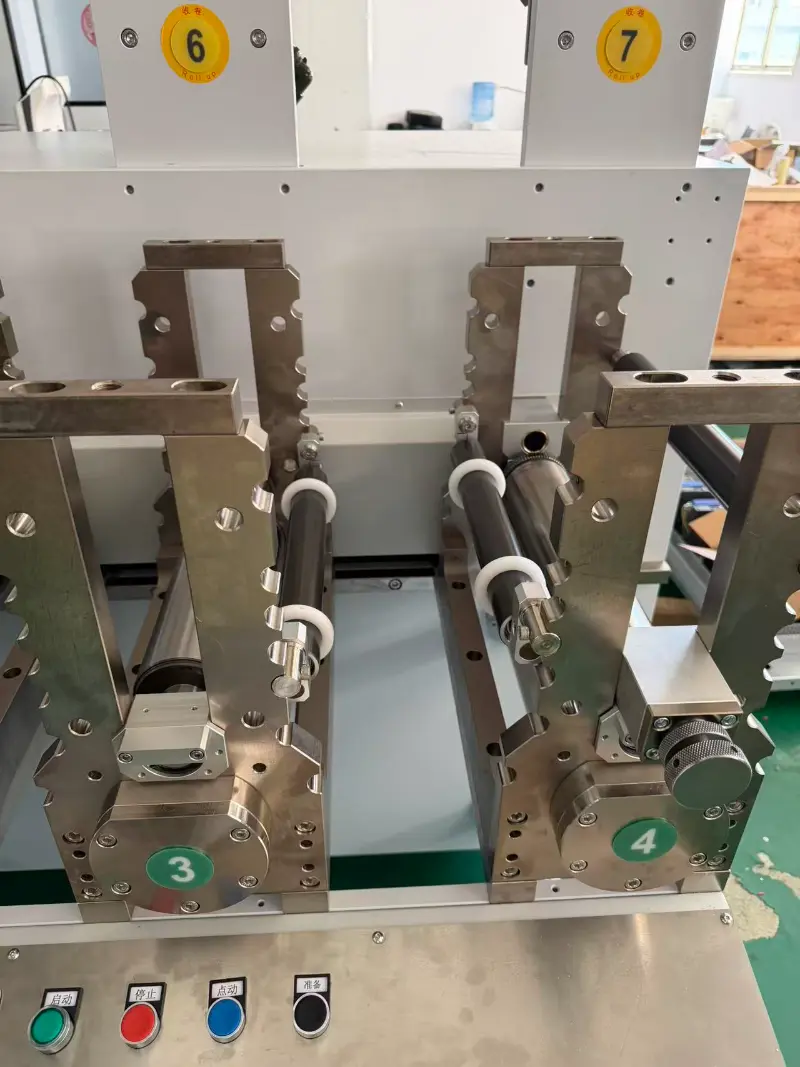
Automation can make process conditions more repeatable, but it does not establish that a finished electrode is safe or effective by itself. Quality planning needs to reflect the product’s intended use, materials, electrical design, skin-contact conditions, and declared shelf life. Depending on the product, manufacturers may need to assess properties such as electrical performance, adhesion, material compatibility, dimensional consistency, and stability over time.
In-line checks can help identify visible defects, missing components, position errors, or deviations from defined process limits before a large quantity of material is processed. Sampling and finished-product testing remain important because not every performance characteristic can be confirmed by a camera or sensor on the production line. Quality records should also link material batches, machine settings, inspection results, and corrective actions so that an issue can be investigated rather than merely detected.
A capable electrode production machine should make critical settings accessible to trained operators and support a documented approach to changeovers and fault handling. The equipment itself is only one part of the quality system; product specifications, validated procedures, supplier controls, operator training, and final testing remain essential.
Before selecting a line, manufacturers should define the electrode designs to be produced, expected output, roll widths, layer construction, connector type, and acceptable changeover time. For example, connector placement, lead-wire attachment, inspection, and packaging requirements can vary considerably between product families.
A practical machine evaluation should include representative samples, material specifications, a proposed process flow, and clear acceptance criteria for trial production. Buyers should ask how recipe settings are stored, how a new size is introduced, which wear parts require regular replacement, and what support is available for installation and operator training.
For manufacturers planning to expand or modernize a line, an ECG Electrode Production Machine should be configured around the required product and verified with its actual materials.
The next stage of ECG electrode manufacturing is unlikely to be defined by automation alone. Its value will come from how well coating, material handling, lamination, cutting, inspection, and production records work together. Plants that combine realistic process validation with well-integrated equipment can make better-informed decisions about output, material use, and quality improvement.
As production requirements become more varied, the most useful automation strategy is to start with the product, map the process, identify sources of variation, and then choose equipment that addresses those needs. With this approach, manufacturers can pursue greater consistency without assuming that higher speed automatically means better production performance.
Copyright © 2026 Xiamen Junssen Intelligent Technology Co., Ltd. All Rights Reserved.
Links Sitemap RSS XML Privacy Policy