

Copyright © 2026 Xiamen Junssen Intelligent Technology Co., Ltd. All Rights Reserved.
Links Sitemap RSS XML Privacy Policy
Junssen, a China-based automation equipment manufacturer and supplier, provides customized Pneumatic Blanking Die solutions for manufacturers seeking consistent cutting quality, flexible tooling configurations, and efficient processing of thin and flexible materials. By using compressed air to drive the cutting mechanism, this type of die can support repeatable blanking operations in packaging, medical consumables, electronics, and adhesive product manufacturing. Selecting the right tooling structure, cutting clearance, and pneumatic configuration helps businesses improve production consistency while managing maintenance requirements and operating costs.
A pneumatic blanking die is a cutting tool powered by compressed air that separates a required component from sheet, film, or other suitable material. Compared with manually operated tooling, pneumatic systems can reduce repetitive manual effort and support integration with production equipment. Their practical value depends on material properties, part geometry, required output, and tooling design. This guide explains how pneumatic blanking works, which materials and industries it serves, how it compares with alternative cutting methods, and what buyers should evaluate before purchasing a customized solution from a manufacturer such as Junssen.
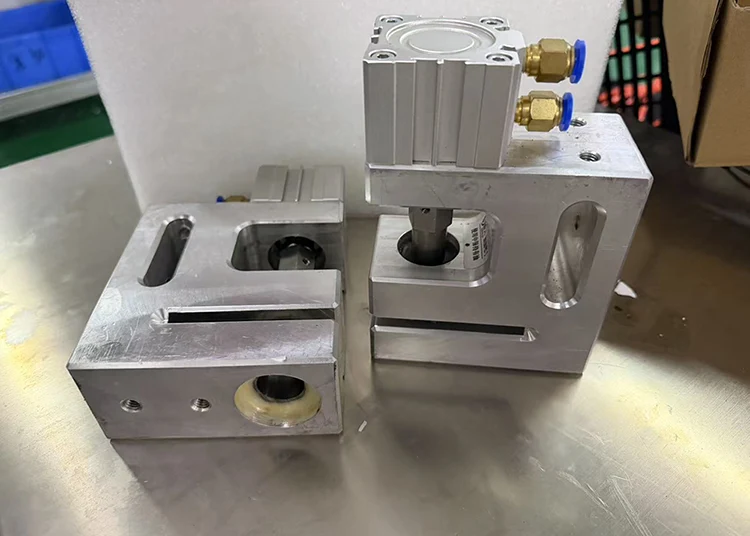
A pneumatic blanking die is a specialized cutting tool that uses compressed air to actuate a punch or cutting mechanism. Its primary purpose is to cut a component with a defined outline from a larger sheet or continuous material. In a typical blanking operation, the separated piece is the desired product, while the surrounding material becomes scrap or a reusable remainder.
The main components commonly include a pneumatic cylinder, punch, die, guide components, and a supporting base. Depending on the application, the tool may be mounted on a fixed press or configured for a suitable mobile or dedicated production setup. Junssen describes its pneumatic blanking die as a compact, lightweight solution that can accommodate different production arrangements.
Another practical advantage is tooling flexibility. When product dimensions or hole positions change, a compatible punch and die specification may be replaced without rebuilding the entire assembly. The exact feasibility depends on the tooling design and the new product geometry.
It is important to distinguish blanking from ordinary hole punching. Blanking produces a separated part with a defined outer profile, whereas punching generally creates a hole or opening in material that remains largely intact. Some production systems combine both functions when the part design requires them.
The operating principle is straightforward: compressed air generates cylinder movement, the cutting element applies force to the workpiece, and the die geometry determines the resulting profile. Successful operation requires coordination between the pneumatic system, tooling clearance, material positioning, and the machine cycle.
For automated production, the die may be integrated with a machine controller, positioning mechanism, or material-feeding system. Before integration, manufacturers should verify stroke timing, available installation space, control compatibility, and the required cutting force.
When the tooling is correctly designed and maintained, a pneumatic blanking system can produce repeatable component shapes across production runs. Accurate material positioning, suitable cutting clearance, and stable pneumatic output are essential to achieving this result. The actual dimensional tolerance must be established for each application rather than assumed from the drive method alone.
Pneumatic mechanisms can provide a practical alternative for applications that do not require a complex hydraulic power unit. A compact assembly may simplify installation in an existing production area, although the overall footprint depends on fixtures, guarding, air preparation components, and material handling requirements.
Because the actuator uses compressed air rather than hydraulic oil as its driving medium, the system avoids hydraulic-fluid leakage associated with hydraulic power circuits. This can be advantageous in production environments handling sensitive films, adhesive materials, or medical consumable components. Nevertheless, compressed-air cleanliness, lubrication requirements, and contamination controls should be assessed according to the specific production process.
Different product shapes may require different punches, die openings, or cutting profiles. A well-planned tooling system can make product changeovers more manageable, particularly when replacement components are designed for compatibility with the existing assembly.
Pneumatic blanking can be incorporated into appropriate automated or semi-automated equipment. Interlocks, guarding, pressure monitoring, and other safety devices can help control access to the cutting area. These safeguards must be selected and validated for the actual machine; pneumatic actuation alone does not guarantee operator safety.
The suitability of a pneumatic blanking die depends on the material's thickness, hardness, elasticity, surface properties, and cutting resistance. It is particularly useful for selected thin and flexible materials, provided that the tool geometry and available force are appropriate.
| Industry | Typical Materials | Potential Applications | Key Consideration |
|---|---|---|---|
| Flexible packaging | PE, PP, PET and other suitable films | Packaging components and shaped film parts | Film thickness, sealing characteristics, and edge quality |
| Medical consumables | Non-woven fabric, hydrogel, adhesive laminates | Electrode pads, dressings, and medical patches | Dimensional consistency and contamination control |
| Electronics | Insulating films, flexible polymers, selected conductive materials | Insulation pieces and thin functional components | Profile accuracy and material deformation |
| Labels and printing | Label stock, paper, adhesive materials | Custom-shaped labels and die-cut components | Adhesive buildup and clean cutting edges |
| Automotive interiors | Flexible decorative films and cushioning materials | Interior trim pieces and shaped pads | Repeatability and compatibility with layered materials |
| General industrial manufacturing | Foam, rubber, silicone, and other suitable soft materials | Gaskets, seals, pads, and protective components | Cutting force, tool wear, and part geometry |
These examples are application possibilities, not a guarantee that one standard die can process every listed material. Multilayer composites, abrasive substrates, thick workpieces, and hard metals may require a different cutting structure or a more powerful machine. A material sample and product drawing help determine feasibility before tooling is manufactured.
Choosing between pneumatic blanking, pneumatic punching, and hydraulic cutting depends on whether the required result is a separate component, a hole, or a cut through a material profile. Buyers should compare the intended process rather than treating these methods as interchangeable.
| Comparison Factor | Pneumatic Blanking Die | Pneumatic Punching Die | Hydraulic Cutting System |
|---|---|---|---|
| Main purpose | Separates a shaped finished part | Creates holes or specified openings | Applies hydraulic force for suitable cutting or forming tasks |
| Power source | Compressed air | Compressed air | Pressurized hydraulic fluid |
| Typical strengths | Defined profiles and repeatable part separation | Efficient hole-making and multi-hole operations | Can deliver high force for demanding applications |
| Maintenance focus | Cutting edges, guides, air supply, and fixtures | Punch condition, hole geometry, guides, and air supply | Fluid condition, seals, hoses, and hydraulic components |
| Selection priority | Part outline, material, and required force | Hole shape, diameter, and position | Force requirements, process type, and system configuration |
A pneumatic blanking die is often worth evaluating when the workpiece is suitable for pneumatic cutting and the required force can be delivered within the system's operating limits. Hydraulic equipment may be more appropriate for heavier-duty applications, while a punching die is generally the better choice when creating openings is the primary objective.
For more information about related tooling, review Junssen's blanking die solutions and blanking and piercing die options.
Purchasing a die based on price alone can lead to unnecessary rework, poor edge quality, or incompatibility with existing equipment. A more reliable approach is to define the production requirements before requesting a quotation.
Junssen's product information indicates that its pneumatic blanking die is compact and lightweight and can support different production configurations. The appropriate design should still be confirmed against the buyer's drawings, samples, and machine specifications.
For a customized tooling inquiry, prepare a package containing the product drawing, material data, sample images, target output, and installation requirements. These details allow the supplier to assess the design more accurately and identify potential constraints before production begins.
Routine maintenance helps preserve edge quality, reduce unplanned downtime, and extend tooling service life. The actual maintenance interval should reflect operating frequency, substrate characteristics, and the manufacturer's instructions.
Excessive air pressure should not be used to compensate for a blunt cutting edge or an incorrectly designed die. Operating beyond specified limits can accelerate wear and damage internal components. Before maintenance, isolate the pneumatic energy source, release stored pressure, and follow the applicable lockout and safety procedures.
If burrs or incomplete cuts appear, first check material positioning, cutting-edge condition, clearance, and pneumatic stability. Adjustments should be based on inspection and the tooling manufacturer's recommendations rather than trial and error alone.
A pneumatic blanking die uses compressed air to drive a cutting mechanism that separates a component from a larger sheet, film, or other suitable substrate. It is used when manufacturers need repeatable shapes and consistent part dimensions.
Depending on the die design and available cutting force, suitable materials may include plastic films, paper, non-woven fabric, adhesive laminates, foam, rubber, silicone, and selected insulating materials. Compatibility should be verified for the specific material thickness and part geometry.
Blanking typically produces a separated piece that becomes the required finished component. Punching generally creates a hole or opening, with the removed slug treated as waste. The correct process depends on the product design.
Junssen provides cutting-tooling solutions for different production requirements. Buyers can submit drawings, samples, material specifications, and equipment details for a technical assessment. The final configuration depends on the application and confirmed design requirements.
Material hardness and abrasiveness, cutting clearance, edge condition, alignment, operating pressure, production frequency, and maintenance practices all influence service life. Regular inspection and timely servicing help reduce premature wear.
Use suitable punch-to-die clearance, maintain sharp cutting edges, secure the workpiece, and keep the pneumatic supply stable. Material properties and tool geometry should be evaluated together when recurring cutting defects occur.
Provide the product drawing, substrate type and thickness, target dimensions and tolerances, expected production volume, host-machine specifications, and any special safety or automation requirements. Samples can also help clarify material behavior.
A well-designed pneumatic blanking die can help manufacturers produce consistent shaped components while supporting flexible tooling arrangements and efficient production workflows. Its suitability depends on the material, cutting geometry, required force, machine compatibility, and expected output. Careful specification and routine maintenance are essential for dependable operation.
Whether you are developing medical consumables, flexible packaging components, adhesive products, or precision industrial parts, Junssen can help assess your tooling requirements and explore a suitable configuration. Visit the Pneumatic Blanking Die product page to learn more, review the relevant automation and tooling solutions, and contact us with your drawings, material details, and production goals to discuss a customized solution for your application.
Copyright © 2026 Xiamen Junssen Intelligent Technology Co., Ltd. All Rights Reserved.
Links Sitemap RSS XML Privacy Policy